
Getting a Supplier Set Up at a UK University: Proforma, PO, New-Supplier Forms and 30-Day Terms
University finance runs on a sequence: requisition, supplier set-up, purchase order, delivery, invoice, payment. Most delays come from starting in the middle.
A UK university does not buy things the way a person does. Money leaves only against a purchase order, a purchase order goes only to a supplier on the finance system, and a supplier gets onto the system only after checks. A researcher who finds a supplier and asks it for an invoice has started at step four of six.
This is the buyer-side sequence as it works in most UK institutions, and the documents each stage needs. Internal forms and thresholds differ between universities, so treat it as the shape to expect and check your own finance pages for the detail. Getting the parcel through goods-in once it is ordered is a separate problem, covered elsewhere in this cluster.
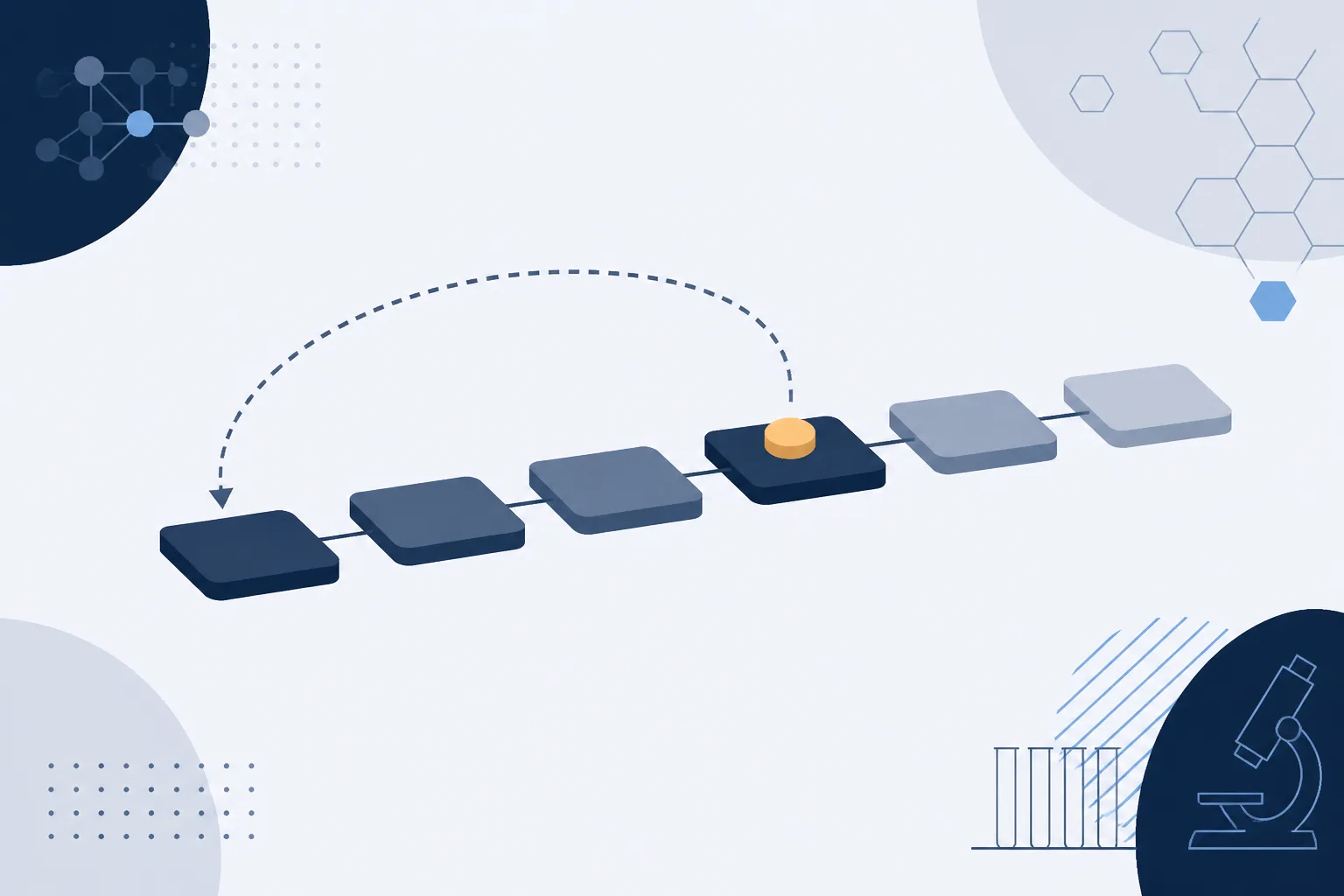
The sequence
| Stage | Who acts | Document |
|---|---|---|
| 1. Requisition | Researcher or lab manager | Internal request with quote, cost code and budget holder's approval |
| 2. Supplier check | Procurement | Is the supplier already on the system, or on a framework? |
| 3. Supplier set-up | Supplier, then finance | New-supplier form, bank details, VAT number |
| 4. Purchase order | Procurement or the finance system | PO number sent to the supplier |
| 5. Delivery and receipt | Goods-in, then the lab | Delivery note; goods receipted against the PO |
| 6. Invoice and payment | Supplier, then accounts payable | Invoice quoting the PO; payment on the agreed terms |
Stages two and three are where the time goes. A researcher can shorten them considerably by asking procurement before choosing a supplier rather than after.
What the new-supplier form asks for
The forms vary, but the questions are predictable. Finance needs to know it is paying a real business, into the right bank account, with the right tax treatment.
- Legal name, trading name and registered address, with a company number where there is one.
- Bank details, usually on a letter or statement on the bank's letterhead, or confirmed by a call-back to a number finance already holds.
- A VAT registration number if the supplier is registered. Finance can check that a UK number is valid and see the name and address it is registered to [4].
- Insurance certificates, commonly public and product liability for suppliers of goods, sometimes with minimum levels of cover.
- Declarations the university requires, such as modern slavery, anti-bribery and data protection, often as a questionnaire.
- Payment terms and an email address for remittance advice.
Respect the bank-detail check. Payment diversion, where a fraudster emails to change a supplier's bank details, targets exactly this step. That is why a university will not accept a change of account by email alone, and why a new supplier is often asked to confirm by letter or telephone. A supplier who resists this is showing you a warning sign, not causing an inconvenience.
Why small suppliers ask for payment up front
A small supplier shipping a few hundred pounds of material to an institution it has never dealt with has no trading history with it, and no appetite for chasing an invoice through an accounts-payable queue. The usual answer is a proforma: a document stating what will be supplied and at what price, paid before dispatch.
A proforma is not a VAT invoice. HMRC's manual for its own staff says a pro-forma invoice should be clearly described as such, preferably endorsed "This is not a VAT invoice", and cannot normally be treated as an accounting document [3]. The supplier issues the proper invoice after payment or supply, and that is the document finance needs to close the transaction and, where the institution recovers VAT, to support its claim.
Universities treat proformas as an exception route. Typically the PO is still raised, finance pays against the proforma, and the final invoice is matched to the PO afterwards. Two things speed it up: a proforma that quotes the PO number, and a supplier who sends the final invoice without having to be chased.
Payment terms: where 30 days comes from
Thirty days is not just a convention. Where a university is a contracting authority under the Procurement Act 2023, the Act implies a term into its public contracts that sums due are paid within 30 days of the invoice being received or the payment falling due, whichever is later [1]. The term does not bind the authority if it considers the invoice invalid or disputes it, and in that case it must tell the supplier without undue delay.
The Act also sets the minimum an invoice must contain to count as valid: the name of the invoicing party, a description of what was supplied, the sum requested and a unique identification number [1]. Universities add one requirement of their own, the PO number, and an invoice without it is the most common reason a small supplier is paid late.
Outside that regime, the general late-payment rules between businesses apply. Where no payment date has been agreed, payment becomes overdue 30 days after the customer receives the invoice or the goods are delivered, whichever is later. Agreed dates should be within 30 days for public authorities, or 60 days for business transactions [2].
Frameworks and single-source justification
Above internal spending thresholds, a university normally has to show it tested the market, through several quotes or a tender. Two routes avoid that.
The first is a framework agreement: an arrangement a purchasing consortium has already competed and awarded, which member institutions can order against. UK higher education runs much of its collaborative buying through eight consortia working together as UKUPC, among them APUC in Scotland, HEPCW in Wales, and LUPC, NEUPC, NWUPC and SUPC in England [5]. If a supplier is on a framework, the competition and much of the set-up have already been done.
The second is a single-source justification: a short written case, approved by procurement, explaining why only one supplier can meet the requirement. For research materials the grounds are usually technical. A particular sequence, purity specification, counter-ion or documentation standard may be available from only one supplier, or continuity with an existing batch may matter. "We have always used them" is not a justification. "Our method was validated on this supplier's material and changing it would mean revalidating" usually is.
What to give procurement on day one
- The supplier's written quote, showing price, currency, delivery charge and whether VAT is included.
- The supplier's contact for set-up paperwork, and whether it is already on the system.
- The technical reason for choosing this supplier, if it is not on a framework.
- The delivery address as goods-in wants it: named person, lab, building and PO number.
- Any documents you need with the goods, such as a certificate of analysis or safety data sheet, stated on the PO so they are part of what is ordered.
The last item matters more than it looks. Documents required on the PO are part of the contract; documents requested afterwards are a favour. Deciding what paperwork must arrive with a delivery is the buyer's half of setting acceptance criteria for incoming material, and the PO is where stating them costs least.
Two related questions sit elsewhere in this cluster. Equipment bought with charitable funds may qualify for a VAT zero rate under a separate HMRC notice, which never extends to consumables. And the rights an institution has when goods arrive faulty come from business-to-business sale law, not consumer law.
References
- Procurement Act 2023, section 68: Implied payment terms in public contractslegislation.gov.uk, 2023
- Late commercial payments: charging interest and debt recoveryGOV.UK
- VATREC9010 - Pro-forma invoices: IntroductionHM Revenue & Customs internal manual, GOV.UK
- Check a UK VAT numberGOV.UK
- About UKUPCUK Universities Purchasing Consortia