
Delivering to a University Department: Goods-In Desks, Mailrooms and the Parcel That Went to Stores
A parcel addressed to a university lab or a hospital research unit almost never goes to the lab. It goes to a goods-in desk, gets booked, and starts a second, internal journey that the courier's tracking page knows nothing about.
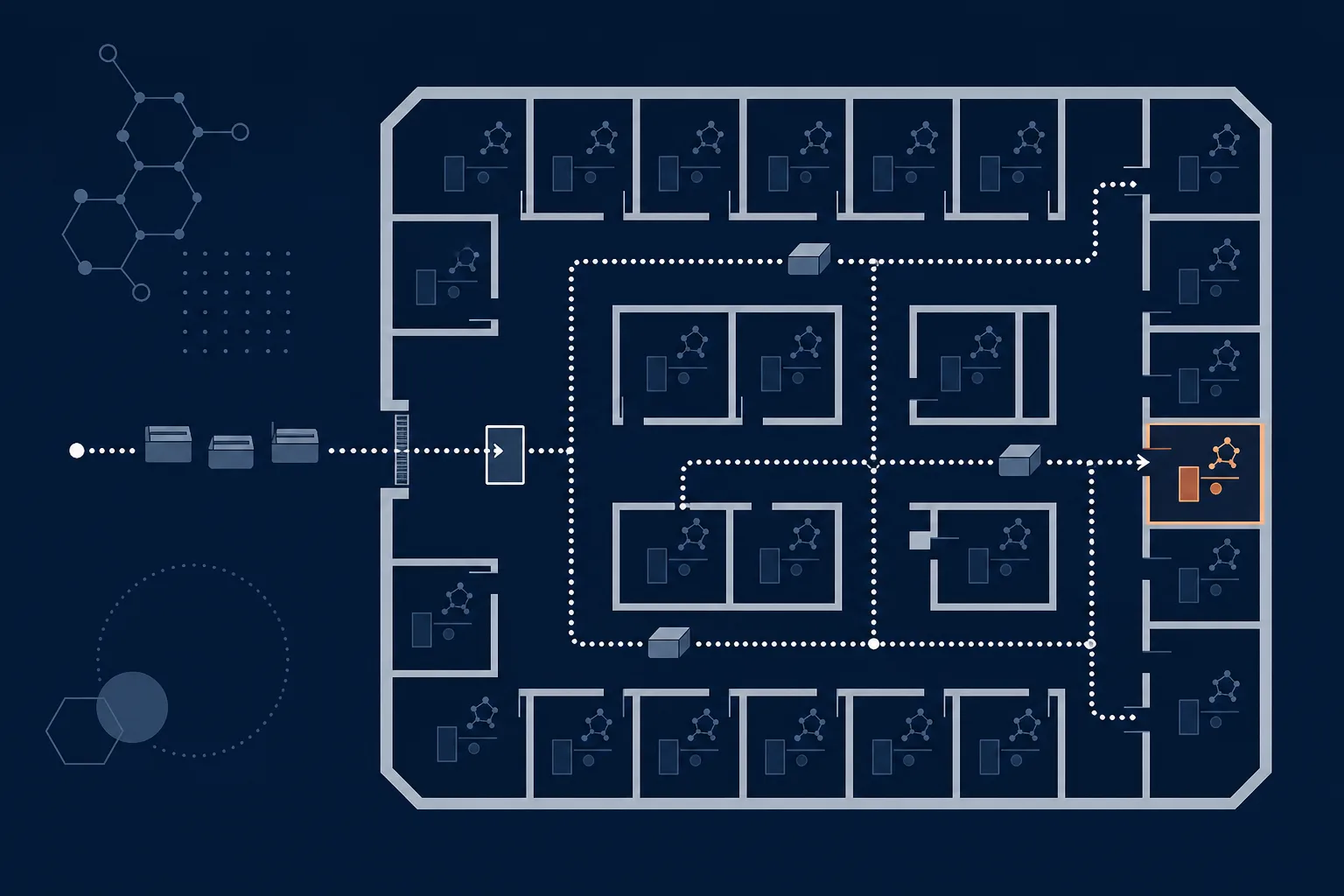
A parcel addressed to a university laboratory or an NHS research unit is almost never delivered to the laboratory. The courier delivers it to a goods-in desk, a post room or central stores. Someone there signs for it, books it in, and later moves it through the site to the department on an internal round. As far as the courier is concerned the job ended at the signature. As far as the lab is concerned it has not started.
Most lost or late institutional parcels go wrong in that second, internal journey, and most of the causes are things that could have been fixed in the address block or with one phone call. How a supplier is set up on the institution's finance system in the first place is a separate process; this article starts when the order has been placed.
How institutional goods-in works
The details vary between institutions but the pattern is consistent. Aston University's published instructions are typical: all deliveries to its main building must go to Goods Inwards in the post room, deliveries are accepted between 08:00 and 16:00 on weekdays except by prior agreement, items must carry the full name of the recipient, a description and quantity of the goods and delivery notes, and post room staff then deliver to the end user. The university states that it accepts no responsibility for goods delivered outside those requirements [1].
NHS trusts work the same way with more process attached. One trust's published receipt procedure describes goods being delivered into stores, booked in and identified by the storekeeper, given a barcode for an audit trail, and distributed by the logistics department to the point of use, with the driver taking a signature to confirm the parcel or roll cage was left and receipted [3].
Two things follow. The courier's proof of delivery will name a storekeeper or post room clerk, not the researcher. And between that signature and the lab there is an internal system with its own timetable, its own rounds and its own opportunities to put a parcel on the wrong trolley.
The address block does the routing
Goods-in staff route parcels from what is written on the label and the delivery note. A label that names only the institution and the street is a parcel that someone has to investigate. Give the supplier a delivery address that answers every question the post room will ask.
| Line | Why it matters |
|---|---|
| Recipient's full name | Goods-in routes to a person; initials and first names get lost |
| Research group and room number | Departments span several buildings and floors |
| Department or directorate | The level at which internal rounds are organised |
| Building name | Many sites have one goods-in serving several buildings |
| Institution, street and postcode | The goods-in address, which may differ from the building's |
| Purchase order number | Links the parcel to an order and a budget holder |
| A direct phone number | Lets goods-in or the courier call someone who knows the order |
The purchase order number deserves emphasis. Institutions tie payment to it: the University of Sheffield states that it will not pay an invoice without a valid purchase order number [2], and NHS procedures stress that order numbers must be quoted on invoices [3]. At goods-in, the same number is how a parcel with a mistyped name still finds its budget holder. Ask the supplier to put it on the label and the delivery note, not only the invoice.
What gets refused or stuck
Refusals are rarely personal. They follow the desk's rules, and the common ones are predictable.
- Arrival outside goods-in hours. A courier arriving at 17:30 finds the desk shut and the parcel goes back to the depot.
- No recipient name or order number. Some desks accept and investigate; others refuse at the door.
- Charges due on delivery. Goods-in will not pay import duty, VAT or a courier's handling fee on someone's behalf.
- Personal deliveries. Many institutions do not accept parcels for staff that are not institutional orders.
- Goods that need special handling and were not announced. A desk expecting a cardboard box and receiving one marked for special handling may hold it until someone responsible collects it.
Each of these is avoided by telling goods-in in advance. Most desks welcome a short email with the expected date, carrier, tracking number, recipient and order number, and some institutions require one for anything unusual.
Temperature on the internal leg
Goods-in desks and post rooms are not cold rooms, and they are not always warm ones either; a loading bay in January is close to outdoor temperature. A parcel that arrives at 15:45 may miss the last internal round and spend the night there. A parcel that arrives on Friday afternoon may spend the weekend.
For a cold-packed order that matters. The supplier's packaging was designed around the courier's delivery time, not the courier's delivery time plus an internal leg. When a parcel does sit overnight, the lab needs a method for assessing a consignment that spent longer out of its packaging window than planned. Better to prevent it.
- Ask goods-in to phone the named recipient when the parcel arrives, rather than waiting for the next round.
- Where the institution allows it, collect in person on the delivery day.
- Ask the supplier to avoid Thursday and Friday dispatch for anything cold-packed.
- Tell the supplier the goods-in hours so the service chosen delivers within them.
- Check whether the department has its own receiving point for cold goods; some do, and some goods-in desks will route to it on request.
Who signs, and what the signature means
A signature at goods-in is a delivery to the institution. The courier's record will show a name and a time, and from the carrier's point of view that closes the consignment. Royal Mail's signature services and couriers alike record the person who accepted the parcel, which may not be the person on the label [4]. Who carries the risk after that point is a question about the contract between the supplier and the institution, covered in the article on safe places, neighbours and signatures.
Inside the institution, the parcel's history is only as good as the internal records. A barcoded stores system gives a trail; a post room with a paper log gives a partial one; a department office where parcels are left on a table gives none. When the parcel does reach the lab, the receiving procedure should start there, with acceptance criteria and a receipt log for incoming material, so that the institution's own trail and the lab's join up.
Retrieving a parcel that went to stores
The tracking page says delivered and the lab has nothing. That is the most common institutional delivery problem, and it has a routine.
- Get the proof of delivery from the tracking page or the supplier: the signatory's name, the time and, if shown, the photograph or location.
- Call goods-in with the tracking number, signatory and time. They can check their log for the internal destination.
- Check the likely wrong destinations: central stores, the department office, a building reception, and another building with a similar name.
- On a multi-site NHS trust or university, check whether the parcel went to a different site's goods-in with the same institutional name.
- If nothing turns up within a working day, tell the supplier in writing with the proof of delivery attached, and keep the correspondence.
Most of these parcels are found within a day, usually on a shelf in the wrong office. The ones that are not found are almost always parcels that arrived without a recipient name or order number, which is the case for spending an extra minute on the address block every time.
NHS sites in particular
NHS trusts add three complications. They often run several hospitals under one name, each with its own stores. Research and development departments may sit in a building some distance from the main loading bay. And trust stores are organised around clinical supply, so a small research parcel competes for attention with pallets of consumables. Name the site, the building and the research unit explicitly, make sure the order number is visible on the outside of the parcel, and tell stores to expect it.
References
- Visiting and Delivering on CampusAston University
- Information for suppliersThe University of Sheffield
- Requisitioning, ordering and receipt of goods procedureRotherham Doncaster and South Humber NHS Foundation Trust
- Royal Mail Tracked 24 and 48Royal Mail